Descending like a silvery stream from the dark heavens, lightning surely is an alluring view to behold. Yet, from the very beginning of life, humans have always feared this phenomenon,knowing the grave dangers concealed in it. Thus, it’s of paramount importance that we take proper measures to avoid the undesirable consequences of lightning strikes.
Therefore, in order to give you a proper understanding about lightning, we thought of unfolding its consequences and means of safe guarding against it, through an interview with one of the most reputed high voltage specialists in Sri Lanka, Emeritus Professor J. R. Lucas of the University of Moratuwa, Sri Lanka.
Professor, let’s start from the very basics. Could you please tell us what lightning really is?
Okay… If you go down to the very basics, it is a huge discharge.Have you heard that small pieces of paper get attracted to your comb after combing your hair, especially when the air is dry? That is due to the electrostatic charges piling up in the comb due to the rubbing action.
The same scenario occurs within thunder clouds due to air movement and charges building up inside the clouds. When the field increases beyond a certain value, about 10kV/cm, then a discharge can occur. Most of the time, these discharges take place within the cloud (a cloud, by the way, is normally few kilometers thick), between clouds or just to the air. Only about 10% of these come to the earth, and that is the lightning we are afraid of. Most lightning occurs from the negative charge centers towards the bottom of the cloud.
Does lightning occur only during rains?
Well, lightning and rain are not necessarily related, but in a tropical country like ours, lightning normally occurs during rain, especially when it originates from the lower part of the cloud.
In rare instances, the thunder cloud may be a few kilometers away and you may still find that lightning occurs from those far away clouds, which you may not see.
Have you heard of the expression “lightning from the blue”?
As a cloud is normally a few kilometers thick, when the positive chargers at its top causes lightning discharges, then it might come from fairly far away, and you may not be able to see the cloud, and you might think that the lightning is coming from the blue sky without clouds. Then again, keep in your minds that not all rain clouds cause thunder.
Sir, lightning strikes are dangerous and that’s a well-known fact. But why?
(Making a serious face)
The main reason why lightning is dangerous is due to the enormous amount of energy that it carries. You may be able to light your room lamp for a whole year from the energy of one lightning strike: And, this energy is dissipated within a small fraction of a second. Thus, the currents encountered can be of the order of twenty thousand amperes and higher, while the temperatures can be even hotter than the sun. These alone make lightning a very dangerous phenomenon.
Moreover, once lightning strikes the ground somewhere, currents start to flow through the ground, like the roots of a tree. This gives rise to a potential difference on the surface of the ground. So, if you keep your feet apart, then a potential difference (i.e. a voltage) may appear between your feet, which in turn may cause currents to flow through your body. This can be lethal. This is illustrated in the figure.
Therefore, not only a person directly struck by lightning, but people in the vicinity could also be killed. This adds to the gravity of lightning strikes. The picture obtained from the internet shows many cows dead under a tree, due to the ground potential rise caused by lightning.
On average, how many deaths are caused by the lightning strikes in Sri Lanka?
Well, that’s not an easy question to give an exact answer. Sometimes, unless directly stuck, one may not know that someone was killed by lightning, especially if he was working in the field. People might even think that he got a heart attack. So, these kinds of deaths are not reported and facts are not available. According to records, around 40-50 deaths are reported to occur every year. Including the unreported ones, it is estimated that about 70 people die per year due to lightning in Sri Lanka.
Professor, not everybody gets struck by lightning. So, based on years of your experience, can you conclude the individuals who are more susceptible to lightning strikes?
First and foremost, you must understand that normally, the probability of being hit by a lightning strike has no direct relationship with individuals as such. Anybody is susceptible to lightning strikes, depending on various facts.
If you are the tallest object in an open field, then you are more exposed to lightning because of the higher field. That is why farmers working in paddy fields, fishermen sailing in the sea and rangers wandering in open areas, become common targets of lightning strikes. So, try to avoid open areas when there is thunder.
Most importantly, if there’s only one tree in an open land, never go under it for shelter, because that is the most likely place to get struck by lightning. If the tree is struck, the potential of it increases and from the tree, flash-overs might occur putting you at a grave danger.
Moreover, the use of electrical appliances, though maybe safe, is not encouraged when lightning activity is high. Because, during lightning, the potential of the plug point might go up, and anybody touching the outer metallic part of an electrical appliance might experience an electric shock.
Sir, if we are in an open field during thunder, and if the field is so large such that there’s no place to run to, then what can we do to save ourselves?
In a such a situation, what you can do is to position yourself such that the effects of lightning on you is minimal.
Try to reduce contact between your feet and the ground as much as possible - keep your feet touching each other at the heel. Crouch down, lower your head and body as much as possible and cover your ears from hands. Once you are crouched down, you might not be the tallest object around. As you are keeping your feet touching each other, the voltage difference between them are minimal (step voltage reduces and the effect from the currents running along the ground can be reduced). A lightning discharge normally encounters a considerable amount of sound. By covering your ears, the harm done to the ear drum can be reduced to a minimum.
Never lay on the ground in order to reduce your height, because that’s probably the worst thing that you can do. As the contact area with the ground goes high, so does the currents flowing through your body.
What is the safest place to stay when it is lightning?
(Thoughtfully) A fully enclosed metal box I might say. You are quite safe there from lightning strikes, but soon will suffocate to death and it will turn to a metal coffin.(Laughing)
(Making a serious face)
Well, my advice is to stay within a well constructed building. But make sure that you are not near to open doors, windows and not in the open areas such verandahs, balconies or courtyards. If you cannot find a building, then the next best would be a metallic vehicle.
Some think that vehicles are much safer than buildings, because they are on top of rubber tires, which is a misconception. If lightning could have come a few kilometers from clouds, few inches are not going to make any difference. The tires in fact help to retain charges on the vehicle body. However, fully covered metallic vehicles act as “Faraday Cages” and prevent us from being struck by lightning strikes. However, if you sit near to a window, you might experience some effects of the lightning flashes that may penetrate some millimeters in the non-metallic portions.
Most importantly, you must avoid getting in or out from a vehicle, when the lightning activity is high. This is because, the vehicle can be charged to a higher potential due to lightning and can be discharged through your body when stepping in or out. So, if you are in a vehicle, wait till all the lightning is over before you step out. If it’s urgent to come out, jump off the vehicle with both feet, without touching any part of the vehicle and be mindful not to step out one foot at a time.
Containers are said to be safe, for the same reason as that of vehicles. But practical containers, where people usually stay inside, such as those you find in construction sites, have large openings for ventilation. While containers, being metal structures, attract lightning strikes, there might be flash-overs at the openings unless a metal mesh is connected across openings. So, my advice to you is to even avoid a metal container if a substantial building is available close by when there is thunder.
Is it okay to use mobile phones and land phones when it is thundering?
When it comes to lightning, mobile phones and land phones behave very differently.
The use of land phones is not advisable as surges can come through the communication wires and harm you. However, it’s quite safe to use a mobile phone, if you do not go to the verandah or other open area to getter better reception, or it is not plugged in to a socket outlet for charging.
Sir, can we use a laptop during lightning?
Of course you can! But make sure that you have removed its power, network or any other cable. If
In short, you can use normal household appliances during lightning, as long as they don’t have any wired connection to the electricity or communication networks. That means if they are supplied by batteries.
you want to connect to the internet, use a dongle.
Professor, all this time you emphasized that we must make sure our appliances do not have wired connections, if we are using them during lightning. What is the rationale?
A good question!
Power lines and communication lines are prone to lightning strikes. Even if they are not directly struck, lightning can induce surges in them. These surges travel along these lines and eventually reach electrical equipment to harm them as well their users.
Many people think that their equipment are safe as long as they are turned off. But that is wrong. Lightning can harm even these equipment as long as they are wired to the power or communication networks.
So, make sure that your electric appliances are disconnected at the socket outlets and no network cables are connected, if you are using them when the lightning activity is high.
Professor Lucas, we could learn quite a lot of interesting facts about lightning. Thank you very much for your cooperation!
So, this marks the end of the first part of our interview with Prof. J.R.Lucas.
Keep in touch with us to discover many other interesting facts related to lightning.
Interviewed and presented by:
Dilini Darmawardana
Himali Lakshika
Nisala Amarasekara
Have you ever tried hiding the remote controller of the air conditioner simply to get rid of the extensive current bill? If so, inverter type air conditioners are just the thing for you!
This particular strategy of energy saving is suggested in a popular TV advertisement, nowadays. As it suggests, with this inverter type air conditioners energy saving up to 60% can be expected. Therefore, it is worth to have a look, how this new phase of technology accounts for the energy efficiency and the performance of the air conditioners.
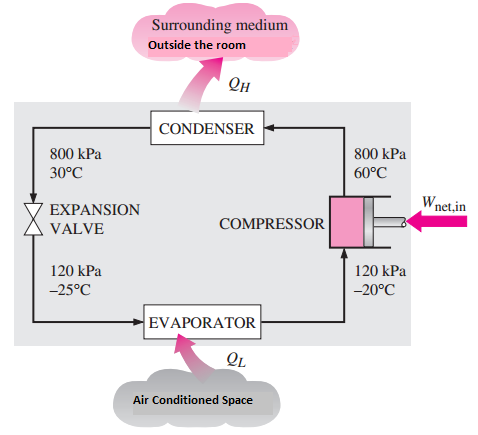
The basic operation of the air conditioners is to extract the heat energy from a compartment area and release it to the outer environment.Therefore, when maintaining the air conditioned space, at a lower temperature, air conditioner has to extract heat energy from a lower temperature medium, and release it to a higher temperature medium. From the second law of thermodynamics (Clausius statement), for this to happen, there should be some external work done somewhere in the cycle. The work needed for this thermodynamic cycle is done by the compressor of the air conditioner.
Operation principle schematic
Thermodynamic cycle in Air conditioners
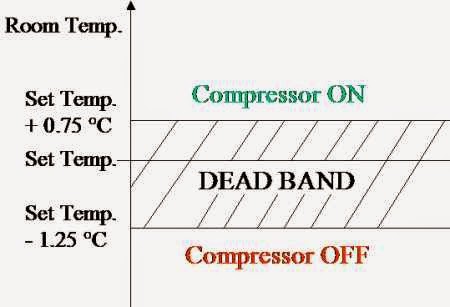
The point of the cycle, where air conditioning can be easily controlled, is the compressor motor. In conventional air conditioners, on off control of compressor is used to maintain the temperature of the air conditioned space around the set value. That is, if the temperature of the room is below the ‘set value-some tolerance’, compressor will completely turn off, whereas if the room temperature rises above the ‘set value + some tolerance’, compressor will completely turn on. A dead band is there to avoid rapid fluctuations of the response around the set point, which would occur otherwise.
On- Off control operation
In inverter type air conditioners, in contrast, the
conventional on- off type control is replaced with a wide range of speed
control technology.That is, with this
new technology, the speed controlling of the compressor is possible rather than
just turning on and off. To control the
speed of the compressor motor (which is an induction motor), over a wide range,
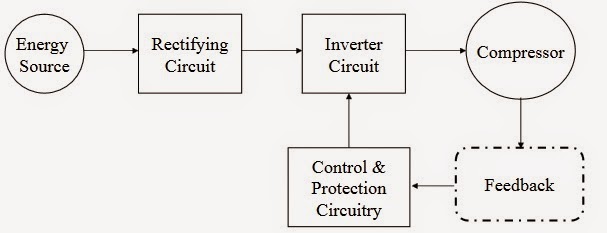
a variable frequency motor drive is used.
Control block diagram of the compressor
Operation block diagram of the inverter
At stating of the air conditioner powerful cooling is required to reach the set temperature.When the set temperature is reached,only a little power is sufficient to maintain the achieved temperature when it comes to inverter type air conditioners. This is achieved by controlling the compressor speed. In contrast, with conventional air conditioners, only the on-off control of high the speed compressor is possible.That in turn results in large fluctuations of temperature.Subsequently this leads to a wasteful consumption of energy.
How much of this wasted energy you can save by replacing the old air conditioner with an inverter type one mainly depends on the factors such as, environmental conditions, thermal insulation of the compartment area, set temperature, rate of change of the room conditions, etc.
Another major plus point with inverter type air conditioners, over the conventional type is its ability to reach the set temperature smoothly and quickly. And also it is capable of maintaining the air conditioned space around the set temperature with a lower tolerance. Due to more precise temperature control, enhanced room comfort can be expected.
With the conventional type air conditioners, sharp fluctuations of voltage which would disturb the other electricity consumers and appliances could occur due to frequent on/off of the compressor. But with inverter type air conditioners, that issue is completely eliminated.
Anyway, with the added complexity due to the introduction of power electronics, production cost tends to increase proportionately. Moreover repairing and troubleshooting of this new inverter, is neither simple nor easy as it is with the conventional one.
Whether you like it or not, conventional air conditioners are now being rapidly replaced by this newly introduced member!
The EESoc panel discussion was initiated with the purpose of serving the power sector with an unbiased and a fruitful discussion regarding a timely issue. Considering the prime importance prevailing in the national power sector, the theme for the year 2013 is suggested as “Towards a rational consumer tariff”. The panel will provide suggestions on how Sri Lanka can move into a more rational tariff structure.
As we believe, the suggestion would definitely be a technically sound and feasible one considering all the engineering and economic aspects in the field. This survey is proposed with intention of integrating social aspects to this proposal to be suggested.
Whatever the suggestions, acceptance of this ultimately depends on the consumer perceptions and their impression on this change. Requirement of a change management programme is a highly essential and important aspect especially in Sri Lankan context. This can be achieved by conducting an effective communication between supply side and consumers, providing accurate information to consumers.
Before moving to a change management program, it is necessary to understand their interest, knowledge, behaviors, beliefs and attitudes towards the electricity pricing. EESoc is expecting to proceed this survey with the intention of all of above mentioned purposes, in collaboration with the EnergyzEE team.
2. Objectives of the Survey
Prepare the sample to represent the actual population based on the consumption of units.
Educate people on the different tariff structures and get a feedback (comments) on the tariff structures according to their personal views.
Get the public perception on the relationship between electricity cost and electricity tariff.
Evaluate the understanding of the public about the load profile in conjunction with electricity tariffs.
Evaluate according to the public perspective what communication channels are best suited to convey information about tariff and how those media could be effectively utilized
Electricity is the key to make us masters of our environment, and most of us take it as a crucial part of our lives. But 150 years ago this was not the case. In the middle of the 19th century labor took place at only sun lit day time, and work itself was manual in slow motion without the aid of machinery. At night people stayed at home to avoid associated risks at night. Over the next century and half we transformed the environment dominated us to an environment dominated by us. Today we experience an electrified environment that responds to our many needs, with power that was transmitted through hundreds of miles in an interconnected transmission grid.
Emerging concept of electricity
In 600BC Greeks first discovered the static electricity that could be generated by rubbing amber, however it wasn’t until 18th century Benjamin Franklin theorized that electrical fluid is made up of charged particles. By harnessing this flow of particles or electrical current, engineers have laid the foundation, what would become the colossus of the modern electricity system, the Power Plant.
Nevertheless the successful integration of this power plants and commercial usage with domestic applications of the power, were made by conflicts aroused between two innovative industrial giants, “Thomas Edison” and “George Westinghouse”. The outcome or the winner of this competition would dominate and dictate how electrical generation and transmission would take place. The competition initiated as a battle to bring safer and low cost electricity to New Yorkers.
Thomas Edison
Nikola Tesla
George Westinghouse
Early, before the electricity, natural gas was made to light the streets and homes of people which were very dangerous. If the lamps went out the gas would continuously get accumulated in the room which eventually will lead to an explosion as there were no shut off valves or to control or detect any malfunction.
Edison and DC system
Poster: Edison's Electric Lamps
Eliminating these limitations, In 1879 Thomas Edison invented the first commercially viable incandescent light bulb which emitted light when heated by passing a low current. Soon he made a design for a complete system for lighting and power distribution method. On September 4th 1882 Edison opened the first electric utility to the mankind, the “Pearl Street Station”, in the heart of lower Manhattan financial district, New York, after many delays and cost overruns. Edison knew that this newly created product is going to be expensive and need to reach many customers in order to survive. However Edison’s choice of Direct Current (DC) made his product into a limited range and he could not transmit the power very far without losing tremendous amount of energy. So basically he would need a power plant every kilometer to provide consistent power to the public. As a consequence of it Edison’s distribution system and being a major investor in DC power, had a web of electric wires overhead, it has sometimes said that they blocked the sunlight at some places.
Edison's DC Distribution Network
Thomas Edison’s competitor George Westinghouse made his company, the “Westinghouse Electric” to perfect the Alternating Current (AC) as Westinghouse saw the future of the electrical industry hinge on long distance transmission. In this contest, Tesla was the key person who influenced AC system of Westinghouse electric company.
Tesla’s intervention
Nikolai Tesla, a Serbian born inventor perhaps the most important contributor to the development of human history as the inventor of power to change night into day, who paved the way to all of our modern electric conveniences with a simple flip of a switch, who envisioned the ground breaking concept for a new electric motor, for which the patent became the induction motor, which would go on to be the standard electric motor of the world.
In 1884, age 28, Tesla moved to New York with little money, to work for Thomas Edison. In fact Tesla redesigned Edison’s electric generators. Though Edison used Tesla’s brilliance, Tesla became unsatisfied with the compensation given to him and left Edison Tech eventually.
Paving the Battle
Tesla knew that there would be a better way to transmit power economically than the DC system and was determined to invent a new system, which would eventually be the global trend - the AC poly-phase system. In 1887 Tesla filed 7 new patents with designs encompass in Alternating Current. The millionaire entrepreneur George Westinghouse thought that those inventions of Tesla will be the key to success in this battle and purchased all of the patents.
As future endurance of the products from both Edison and Westinghouse would largely depend on the electrification method, the war was initiated and developed gradually to ensure quality of relevant electrification systems. This was not a mere battle between Thomas Edison vs. George Westinghouse, this was essential as the technology won would dominate the industry for the foreseeable future.
For the next 2 decades, the battle of currents began both sides fighting for their own survival, even may be taking bitter turns. Expect the rest of the war of AC vs. DC from EnergyzEE.
Battle between drought and electricity demand “Switch off a light and save for future”. This is not a strange slogan for Sri Lankans as it was regularly being broadcasted through various media channels within the last few months. In recent times, ceylon Electricity Board has been experiencing in a crucial crisis due to the inability to satisfy electricity demand in the country, which adversely impacted on the generation plan and financial estimations. Main reason for this was unexpected drought prevailed. Water levels of all the reservoirs were low and hydro generation was strictly scheduled for a limited time period.
Countries such as Sri Lanka have to inevitably face numerous problems under such weather condition, since generation from hydro sources contributes to a significant portion of total generation in the country. Hydro and other sources weigh 40% and 60% from total generation respectively in a period with average hydrological conditions. Hydro generation came down below 20% during this season and the deficit of electricity demand had to be purchased from independent power producers (IPPs) who generate power using diesel, incurring substantial amount of rupees during the peak time.
DSM as a solution As an immediate solution to mitigate the problems arises, supply side had to be equipped with demand side management (DSM) tools. As a basic step, supply side tried to control the electricity demand by managing consumer behavior towards energy saving. This was the point where above mentioned slogan came into play through public media like Television, Radio, Newspapers, Social network…etc. All these urged to save electricity by avoiding unnecessary usage. As night peak hours from 6.30 p.m. to 9.30 p.m. are more critical in this case, their attention was mainly focused on night peak hours. Though morning peak hours from 5.30 am to 6.30 am deliver less impact, as electricity consumers, our attention should be given to that period as well. This campaign was successful to a certain extent with the theme of “Janawiduli balagara”.
But the real situation is, consumers don’t have a proper understanding about these peak hours and the advantages of saving electricity during peak hours. It might be an easy task to stimulate consumers towards positive attitudes in energy saving, if they have a clear view and understanding regarding the load profile of Sri Lanka.
Behavior of load profile Load Profile is a chart in which electricity demand is plotted against the time, 24 hours of a day. The shape of this chart is almost same on all five weekdays. But it gets deviated slightly on weekends and holidays. Following graph represents the load profile of a normal weekday.
The above load profile extracted from the energy balance 2010, illustrates the variation of electricity demand for a day within year 2010 with an average hydrological condition. It is apparent that the Sri Lankan load profile is fluctuating significantly between numerous peaks and valleys. Two specific time slot of this graph could easily catch the eyes and those are well-known as the peak hours.
Peak hours are the time periods in which the electricity demand is significantly higher than the average demand level. As per the diagram illustrates, 5.30 a.m. to 6.30 a.m. period is identified as “Morning peak” and period from 6.30 p.m. to 9.30 p.m. is identified as “Night peak”. It is evident that demand is very low during the midnight and early in the morning. The time slot from 2.00 a.m. to 4.00 a.m. reports the lowest demand within a day which could be identified as the “Base load” of the system.
Next article of this series will bring you a comprehensive analysis of load profile, a discussion on the criticality of peak hours and the importance of providing a general understanding about them to the public in the way of effective utilization of electricity.
Terminology
IPP- Independent power producer is an entity which is granted with permission to generate electricity for sale to utilities and end users
Supply side- This includes all the bodies that are responsible for power generation, transmission and distribution
DSM-Demand side management is a method of encouraging the consumers to use energy efficiently and effectively.
“When we talk about power generation situation, we have to consider three issues namely; adequacy of generation, cost of generation and the generation mix” said Dr. Tilak Siyambalapitiya, senior energy consultant, during an interview with EnergyzEE team.
Dr. Thilak Siyambalapitiya
Dr. Siyambalapitiya graduated from University of Moratuwa, and earned his PhD from the University of Cambridge. He carries 30 years of experience in the energy sector of Sri Lanka, as well as in the region. He has worked in Ceylon Electricity Board, and in Saudi Arabia, on power sector planning and policy. He is a Chartered Engineer, and a Past President of Sri Lanka Energy Managers Association. He is currently an international energy consultant, working with countries in Asia and Africa.
This is the first phase of the discussion the EnergyzEE team had with Dr. Siyambalapitiya.
Adequacy of power generation in Sri Lanka
What do you think about the current situation in terms of generation capacity in Sri Lanka?
“Sri Lanka has adequate generation capacity as for now, and if we continue with the generation projects that are ongoing as well as being planned, and build them on time, there should be no capacity shortages”.
Then why did we have power-cuts in August, last year?
“Last year was one of the driest years for hydro. As a result, annual hydropower generation dropped to 2700 GWh from the planned generation of 4100 GWh. But, one might ask, “there is so much of rainfall data for 100 years; therefore could this not be foreseen?” Yes, it is foreseen. If you take the long term generation plan published by CEB, the criterion on which generation planning is done is that the generation system should be able to meet the demand even if the third driest year in the history occurs again. If you take the long term plan prepared 10 years ago, we were to have the entire Puttalam power plant operational by now. But we have only one generator. Other two are still under construction. So if we had those two units as well, we would have an additional 600 MW.”
“Due to delayed implementation of the plan, we did not have adequate thermal capacity to meet this eventuality. And also, there were simultaneous outages of thermal power plants in August. Therefore we had shortages for a period of about three weeks. So if the plan was implemented on time, we would not have any difficulty at all.”
You have been continuously speaking about a similar situation occurring on the proposed coal power plant in Sampur.
“Well, our next crisis will be in 2017. In fact, electricity crises are easier to predict than human actions, because at least we have some data. I said average rainfall could have given us 4100 GWh last year, but actually we got 2700 GWh. We know the limits. Basically plus or minus 30% from the average is what we get. Therefore, although rainfall is so variable, we know the boundaries, and therefore we can plan for it.”
“Most of the current oil-fired power plants are to be retired by 2015. Given how projects are being implemented, 2017 is another critical year because Trincomalee power plant is not ready yet. Its construction work is yet to be started. To have a big power plant ready by 2017, the construction work should have started now. It takes a minimum of four years to build a big power plant. But we are nowhere near starting the work. Therefore, 2017 will be critical again.”
“And of course, if the rainfall is bad in 2017, the authorities can blame the weather. But we don’t have to blame the weather because the rainfall statistics are known. The ‘real reason’ is not the bad weather, but the delay in starting the projects. That delay becomes visible and acute, when rainfall goes below the average. As I said, if the plan is implemented on time, there should be no problem persisting. Otherwise, what are planning engineers for? CEB is maintaining four full time planning engineers just to plan the generating system in the future. There should be no problem if their recommendations are implemented.”
“The problem is, now people are arguing about ‘Coal Trinco’ (Sampur) power plant without making a decision. “Do we really need it?”, “Can’t we make it a gas-fired power plant?”, “Do we have to do it with Indians?” are such arguments. Therefore, the project is getting delayed, and we will be in trouble.”
Then what would be the solution for this, under your opinion?
“As I always say, decide first for the long term, and then look for any quick solution for that window. The mistake we have been doing in the past, since about 1992, is that we don’t make decisions on the elements of the long term plan. Then, say about two years ahead of a crisis, suddenly everybody wakes up and says that we must do something for this. Then various bright ideas come in; for example, one such bright idea is “Let’s advertise saying that we need 300 MW in two years. So, let the private sector propose how they can bail out the country with 300 MW and deliver in two years.” But we know that nobody can build a decent 300MW power plant in two years. The only thing you can do is buying a readymade one. You can’t get any readymade Nuclear, Coal or Gas power plant; the only readymade power plant you can get is an oil-fired one. So we get the private sector to do what they like, what they can do. The politicians and funding organisations such as ADB, World Bank would like that very much because we are getting private sector to do power generation; so we are breaking the monopoly of the government and CEB in the business of power generation. Nobody discusses the real issue that we are getting a wrong type of power plant. And that’s why we have a legacy of 10 oil-fired power plants, all done by the private sector. So all I say is, that’s a short term unqualified solution.”
“Let’s take things as of today. It’s true that decision on Trincomalee has been delayed. We can’t keep crying about what happened in the past. So today, we should fast track it, and see how we can get it by 2017. Even if we can’t get it by 2017, we can get it by 2018. Then of course, we know that a crisis is coming up in 2016, 2017. Then we can get CEB planners to quantify the likely severity of this crisis. Then if we can get over it by having load shedding for about two months selectively, then perhaps we can tell the customer in advance about the problem and keep them well informed until we recover it with our long term solution. So the solution to the crisis is deciding first and making realistic decisions.”
“We have been discussing with India for the last six years, in terms of this particular power plant, but still there is no conclusion. I don’t think any decent government or even a private sector company would negotiate anything for six years. If it doesn’t work out, you should look for some other opportunities. In my view, we have had enough discussions with India. For whatever reason, may be economic or political or whatever, they can’t reach an agreement.”
“But there are other avenues. We can invite joint CEB – private sector partnership. We have local companies who have now experience in building private power projects. And what we basically need is USD 500 million of investment, and it’s not a huge amount for our private sector now, but the offers must be competitively selected, and as the Electric Act says, Government must be a shareholder. Negotiated agreements with the Sri Lankan private sector have been seen to be very expensive.”
“Otherwise, Japanese may still be willing to finance the Trincomalee power plant, provided that it is a ‘super critical’ power plant. Super critical power plants operate at much higher temperatures and pressures, and they are usually about 2% more efficient than the conventional technology. But, there is a catch. Super critical power plants are big. The smallest unit size is 600 MW. So, as a single generator, 600 MW is too large in our tiny power system. The issue is the risk. If the big generator trips, there will be a system blackout. So, it’s also a choice that can be made, if we want, whether to take the risk or not. We can inform the public about the risk of possible blackouts, and make a decision to build a super critical power plant. But, as demand grows, that problem too will also fade away by 2020 or so. Our peak demand will be much higher then, and a 600 MW single generator will not be an issue.”
How do you compare the power generation situation in Sri Lanka with other developing countries in the region?
“If we compare ourselves with India, Pakistan, Bangladesh and Nepal, our immediate neighbours in South Asia, we are the only country that provides adequate electricity throughout the year. Nepal is having 12 hour load shedding in winter. In summer, Bangladesh sheds about 30% of the demand. India sheds 12% and Pakistan sheds up to 50%. There are electricity riots in Pakistan; people are going in procession asking the government to give them electricity. So, Sri Lankan generation situation is better when comparing with those four countries in the region.”
“However, Maldives is completely different from them. Maldives is a tiny neighbour but has a lot of financial resources. They provide 24 hour electricity to all the islands using diesel generators, at a subsidized price.”
“Elsewhere in the Asian region, most of the countries meet the entire requirement; there is no long term load shedding. In terms of adequate capacity, we are comparable with them. But, in terms of reliability, countries like Singapore, Malaysia and Thailand far ahead of us."
“Overall in comparison with developing countries in the world, we are not at the top, but somewhere in the middle.”
The discussion continued to the areas of cost of generation and generation mix in Sri Lanka. You can meet Dr. Siyambalapitiya again through EnergyzEE soon. Stay in touch with EnergyzEE.
Not a stranger, but while treated most of the times even worse than a stranger, the billing officer is used to visit our places once a month. It’s most of the times antagonizing to see a substantial amount written on the bill, especially when we feel that we didn’t consume THAT MUCH !! But the problem is how we identify THAT MUCH quantity?
The small device the billing officer looking at, while pressing the buttons of his calculator and taking down notes, is colloquially known as the “Meter”. But ideally, it should be the Domestic Electrical Energy Meter. However, the electricity bill itself refers to this device as the “Meter” (Doubt me? Just have a glance at the electricity bill of the last month), authenticating the use of that simple singular word, instead of a complex tech jargon. Domestic Electrical Energy Meter is capable of measuring the total power consumed passed through it. The electrical supply to the house passes the meter, recording those quanta of power is consumed.
The theory behind the energy meter is what we learned in the secondary school. Power consumed by any electrical device is simply equal to the value of the voltage times the current. However, in a broader analysis, domestic electrical energy meter measures only the active power consumed by the equipment. The reactive power consumed is ignored in domestic measurements of power. But in industrial applications, demand meters are used to measure the maximum apparent power consumed, which is the vector sum of active and reactive powers.
Getting back to the domestic meter, the old fashioned meters have two coils, namely the voltage coil and the current coil, and a rotating disc. The interaction of flux generated by the two coils induces eddy currents on the disc. These eddy currents react with the magnetic flux and exert a rotating torque on the metallic disc. Now I know you doubt why this disk is not accelerating because of the torque, which should be the normal behavior. The disk is damped using a permanent magnet to deliver a reverse torque. This balances the torque and cause the meter to rotate in a constant speed, which is directly proportional to the electrical energy passed through. The spinning dials rotate accordingly to record the number of turns the disk is rotated, which is the indication for the consumption of power.
The digital energy meters replaced the demand to those mechanical meters, with sophisticated electronic components integrated into a smaller volume. Evolvements of meters in terms of technology is significant, and now we see smart meters which are capable of communicating with remote sources through GPRS or other similar telecommunication methods , to transfer energy data. All the meters imported are tested on a sample basis at the meter testing lab at Ja-Ela, owned by Lanka Electricity Company Limited.
Knowing all about meters will not help your pocket by any means, unless you understand the tariff structure. It is worth for any consumer to have an understanding about the tariff structure for the domestic customers.
The process of calculating the energy charge is simple. The meter reading depicts how many units the consumer has used.Domestic tariff is a block tariff and the table shows the tariff structure for a 30 day billing period. Billing period is the number of days from the previous billing date to the current billing date. The size of the block depends on the billing period. For example if the billing period is 32 days, the first block will be 0-32 kWh and the 5th block will be 129-192 kWh. Based on the interval to which the last unit is falling to, the fixed charge is decided. This prevent the customer from moving into a higher fixed charge, because of the delay of billing officers visit. Number of units used in each interval is multiplied by the respective energy charge and added together to form up the total energy charge. The fuel adjustment charge is a percentage of energy charge, calculated according to the table below. More details on this calculation process will be available in the next article on metering.
At a glance it is noted that both the fixed charge and the energy charge per kilo watt hour jumps up abruptly at the 90 unit margin. Therefore, if you are mindful to manage your consumption below 90 units, that will be at your advantage. Try the bill calculator in EnergyzEE blog, you will be able to calculate your own bill in a split second. Tricks to save the bill is yet to come with Energy zEE


 Thursday, March 05, 2015


 Well, lightning and rain are not necessarily related, but in a tropical country like ours, lightning normally occurs during rain, especially when it originates from the lower part of the cloud.
 Therefore, not only a person directly struck by lightning, but people in the vicinity could also be killed. This adds to the gravity of lightning strikes. The picture obtained from the internet shows many cows dead under a tree, due to the ground potential rise caused by lightning.


 A fully enclosed metal box I might say. You are quite safe there from lightning strikes, but soon will suffocate to death and it will turn to a metal coffin.(Laughing)
 Some think that vehicles are much safer than buildings, because they are on top of rubber tires, which is a misconception. If lightning could have come a few kilometers from clouds, few inches are not going to make any difference. The tires in fact help to retain charges on the vehicle body. However, fully covered metallic vehicles act as “Faraday Cages” and prevent us from being struck by lightning strikes. However, if you sit near to a window, you might experience some effects of the lightning flashes that may penetrate some millimeters in the non-metallic portions.
 Most importantly, you must avoid getting in or out from a vehicle, when the lightning activity is high. This is because, the vehicle can be charged to a higher potential due to lightning and can be discharged through your body when stepping in or out. So, if you are in a vehicle, wait till all the lightning is over before you step out. If it’s urgent to come out, jump off the vehicle with both feet, without touching any part of the vehicle and be mindful not to step out one foot at a time.
 Of course you can! But make sure that you have removed its power, network or any other cable. If

 Posted in: Utility and Social