What is so special about Inverter type Air Conditioners….


Have you ever tried hiding the remote controller of the air conditioner simply to get rid of the extensive current bill? If so, inverter type air conditioners are just the thing for you!

This particular strategy of energy saving is suggested in a popular TV advertisement, nowadays. As it suggests, with this inverter type air conditioners energy saving up to 60% can be expected.  Therefore, it is worth to have a look, how this new phase of technology accounts for the energy efficiency and the performance of the air conditioners.

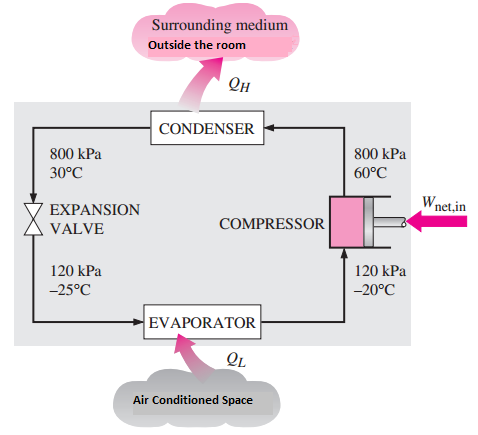
The basic operation of the air conditioners is to extract the heat energy from a compartment area and release it to the outer environment.Therefore, when maintaining the air conditioned space, at a lower temperature, air conditioner has to extract heat energy from a lower temperature medium, and release it to a higher temperature medium. From the second law of thermodynamics (Clausius statement), for this to happen, there should be some external work done somewhere in the cycle. The work needed for this thermodynamic cycle is done by the compressor of the air conditioner.

Operation principle schematic
Thermodynamic cycle in Air conditioners

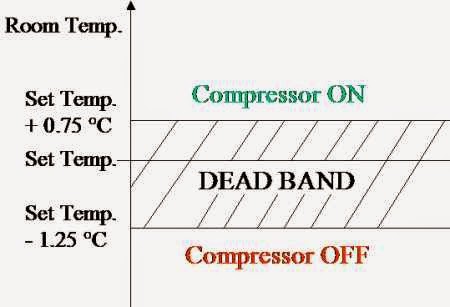
The point of the cycle, where air conditioning can be easily controlled, is the compressor motor.  In conventional air conditioners, on off control of compressor is used to maintain the temperature of the air conditioned space around the set value. That is, if the temperature of the room is below the ‘set value-some tolerance’, compressor will completely turn off, whereas if the room temperature rises above the ‘set value + some tolerance’, compressor will completely turn on. A dead band is there to avoid rapid fluctuations of the response around the set point, which would occur otherwise.

On- Off control operation

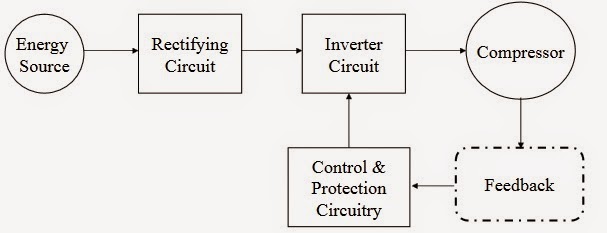
In inverter type air conditioners, in contrast, the conventional on- off type control is replaced with a wide range of speed control technology. That is, with this new technology, the speed controlling of the compressor is possible rather than just turning on and off. To control the speed of the compressor motor (which is an induction motor), over a wide range, a variable frequency motor drive is used.

Control block diagram of the compressor

Operation block diagram of the inverter

At stating of the air conditioner powerful cooling is required to reach the set temperature.When the set temperature is reached,only a little power is sufficient to maintain the achieved temperature when it comes to inverter type air conditioners. This is achieved by controlling the compressor speed. In contrast, with conventional air conditioners, only the on-off control of high the speed compressor is possible.That in turn results in large fluctuations of temperature.Subsequently this leads to a wasteful consumption of energy.

How much of this wasted energy you can save by replacing the old air conditioner with an inverter type one mainly depends on the factors such as, environmental conditions, thermal insulation of the compartment area, set temperature, rate of change of the room conditions, etc. 

Another major plus point with inverter type air conditioners, over the conventional type is its ability to reach the set temperature smoothly and quickly. And also it is capable of maintaining the air conditioned space around the set temperature with a lower tolerance. Due to more precise temperature control, enhanced room comfort can be expected. 

With the conventional type air conditioners, sharp fluctuations of voltage which would disturb the other electricity consumers and appliances could occur due to frequent on/off of the compressor. But with inverter type air conditioners, that issue is completely eliminated.

Anyway, with the added complexity due to the introduction of power electronics, production cost tends to increase proportionately. Moreover repairing and troubleshooting of this new inverter, is neither simple nor easy as it is with the conventional one.

Whether you like it or not, conventional air conditioners are now being rapidly replaced by this newly introduced member!

References:

Article By: Thisandu Kahingala 

Pumped Storage: A battery with a promising potential

Even though most people are familiar with the basics of conventional hydro, pumped storage is still a quite unfamiliar concept which provides solutions to some of the vital problems faced in the general power systems. One of the important usages of pumped storage comes in to play in matching constantly-changing supply from power producers with constantly-changing demand of power consumers by acting as a facility that can supply extra power when demand increases by taking in extra power when supply stays high while demand drops. Other than that, it is also considered as the largest capacity form of grid energy storage available, providing a large scale energy storage option for intermittent power sources. These points would be discussed extensively later in the article as it is important to first identify what pumped storage is exactly.
  
What is pumped hydroelectric storage?

A pumped hydroelectric storage facility typically consists of pumps/generators connecting an upper elevation reservoir and a lower elevation reservoir (As shown in Figure 1).

Figure 1: Basic overview of a pumped hydroelectric storage facility (Extracted from http://www.bbc.co.uk/bitesize/standard/physics/energy_matters/generation_of_electricity/revision/3/)

This method stores energy in the form of potential energy of water, pumped from the lower elevation reservoir to the higher elevation reservoir. The pumps utilize relatively low-cost electricity from the grid during off-peak hours to move water from the lower reservoir to the upper reservoir to store energy. During periods of high electricity demand (peak-hours), the stored water is released through turbines to produce electric power.

Pumped storage as a load balancing tool:

This specific function could be efficiently portrayed through the Sri Lankan power system, where the daily electricity demand fluctuates significantly and the late evening peak demand (around 2000 MW) is more than double the off-peak demand (around 800 MW). This situation leads to the requirement of developing generation facilities to serve the peak demand specifically.  (Sri Lankan daily load curve (in general) is shown in Figure 2)

Figure 2: Sri Lankan Electricity demand load curve (Extracted from
http://www.nalakagunawardene.com/tag/power-load-curve/)

Currently this high peak demand is satisfied through diesel/heavy fuel fired thermal plants (if the hydro generation capacity is not enough) which leads to a higher generation cost per unit whereas during off peak, plants with lower generation costs (e.g. coal fired power plants) are part loaded due to low demand making them inefficient (under-utilized).

This imbalance points us to the function of a pumped storage as a load balancing tool where during off peak, the pumps could utilize low cost energy by full loading the coal fired power plants and during the peak, the stored water could be used to satisfy the high demand presenting an economically advantageous situation than the normal conditions.

Even though pumped storage might be a novel concept in the Sri Lankan context, it has been utilized effectively in many countries over the world for this specific function.

Pumped storage as a battery for renewable energy:

It is known fact that one of the main drawbacks of electricity generation using renewable energy sources like wind, solar etc. is the high amount of intermittency present and the lack of suitable energy storage system which compensates to this intermittency.

Pumped storage is considered as a possible solution to this issue as it provides an energy storage opportunity, as potential energy in water in larger capacities. Already pumped storage systems are built on research basis which use wind turbines or solar power to drive water pumps directly, thus providing a more efficient system to smooth out the variability of energy captured from the wind or sun. (Example: Ringwall- storage-hybrid power plant in Germany)

Prospects for future:

Even though there are many new research concepts and novel ideas popping out regularly regarding  pumped storage technology, few stands out among those as really bright prospects for the future. One of them is utilizing sea-water for a pumped storage plant which Japan has already pioneered. The Okinawa seawater PHS station, which has commenced operation in 1999, is the world’s first seawater pumped storage facility.

Also researchers had proposed the possibility of utilizing an underground cavern as the lower reservoir for a pumped storage project. Recent examples include the proposed Summit project in Norton, Ohio, the proposed Maysville project in Kentucky (underground limestone mine), and the Mount Hope project in New Jersey, which have used a former iron mine as the lower reservoir.

Where Sri Lanka stands regarding this technology:

Sri Lanka as a country primarily based on hydro resources to generate power, should possess the suitable terrains with significant elevation difference between the two reservoirs and significant amount of water resource. Studies have already been conducted in this regard and several possible sites have been identified for a pumped storage facility. One of the main candidate sites is “Kiriketi” which is based on Kiriketi Oya- North of Samanalawewa Reservoir. More details about these studies could be found in the original research paper “PLANNING OF PUMPED STORAGE POWER PLANTS IN SRI LANKA” by MTAP Wickramarathna published in SLEMA Journal,Vol 14,No.2, September 2011.
(http://www.slema.org.lk/news_events/SLEMA-Journal/SLEMA-Journal-Sept-2011.pdf)

It could be concluded that, in the Sri Lankan context, a pumped storage facility could be a valuable addition to the power system as it provides a platform to operate the system more economically by utilizing the low cost coal power plants coming up and an opportunity to integrate more renewable energy sources to the system.

References:

http://thinkprogress.org/climate/2013/08/27/2524501/hydro-pumped-storage-climate-change/
http://www.renewableenergyworld.com/rea/blog/post/2013/11/pumped-storage-in-the-spotlight
http://en.wikipedia.org/wiki/Pumped-storage_hydroelectricity

Article By: Asith Kaushalya and Chathuranga Fernando

Evaluating the public perception on domestic electricity tariff structure | Survey


Go to survey (English version)
Go to survey (Sinhala version)

1. Purpose of the Survey

The EESoc panel discussion was initiated with the purpose of serving the power sector with an unbiased and a fruitful discussion regarding a timely issue. Considering the prime importance prevailing in the national power sector, the theme for the year 2013 is suggested as “Towards a rational consumer tariff”. The panel will provide suggestions on how Sri Lanka can move into a more rational tariff structure.

As we believe, the suggestion would definitely be a technically sound and feasible one considering all the engineering and economic aspects in the field. This survey is proposed with intention of integrating social aspects to this proposal to be suggested.

Whatever the suggestions, acceptance of this ultimately depends on the consumer perceptions and their impression on this change. Requirement of a change management programme is a highly essential and important aspect especially in Sri Lankan context. This can be achieved by conducting an effective communication between supply side and consumers, providing accurate information to consumers.

Before moving to a change management program, it is necessary to understand their interest, knowledge, behaviors, beliefs and attitudes towards the electricity pricing. EESoc is expecting to proceed this survey with the intention of all of above mentioned purposes, in collaboration with the EnergyzEE team.

2. Objectives of the Survey

  • Prepare the sample to represent the actual population based on the consumption of units.
  • Educate people on the different tariff structures and get a feedback (comments) on the tariff structures according to their personal views.
  • Get the public perception on the relationship between electricity cost and electricity tariff.
  • Evaluate the understanding of the public about the load profile in conjunction with electricity tariffs.
  • Evaluate according to the public perspective what communication channels are best suited to convey information about tariff and how those media could be effectively utilized

Introduction to Wind Power Plant technologies in the world


Renewable energy is the main concern of the global energy sector to face the energy crisis occurred with the depletion of fossil fuel. Wind energy is one of the prominent renewable sources of energy currently used globally. Following the global trend, Sri Lanka too has wind power plants connected to the national grid that consist of three main types of generators which are variable speed synchronous wind generators, doubly-fed induction wind generators and fixed speed asynchronous wind generators (FSAWD). This article talks about the main construction modes of each type of wind power plant available globally.

Fixed speed asynchronous wind generator

These types of generators are operated with less than 1% variation of rotor speed, which is also the reason to be called as fixed speed wind generators. They are equipped with a squirrel cage induction machine which is directly connected to the power grid (Figure 1). The speed of the rotor is determined by the frequency of the network not from the wind speed. It is done with the speed multiplier ratio and by the generator type. In order to increase the power production, most of the wind generators use two coils for low wind speed and high wind speed. There are 8 poles and 4-6 poles available respectively for each type of coils. These generators have used soft starters as for starting up of the generators since starting current is very high and it might also be a cause for voltage variation in weak power system network.

Mainly there are two types of fixed speed wind turbines available in the industry as pitch control and stall control. In pitch control type turbines, blades are not fixed to the hub so it can be rotated a few degrees to fully confront the wind in order to produce full power or be in line with wind direction to extract no power. In stall control type turbine blades are fixed to the hub rigidly and they are designed in a way that the airflow over the blades is a laminar air flow to turbulence flow at high speed.  But the drawback is, rigidly fixed blades limit the mechanical power extracted from the wind at high speed to protect the machines from overloading.


Wound rotor induction generator

Wound rotor induction generators use variable rotor resistance control in order to achieve output power control. These types of wind turbines can extract wind power in a optimum way, compared to squirrel cage induction wind generators so they are generally employed with variable speed wind turbines. They are stall controlled wind turbines (blades are rigidly fixed to the hub) to focus on the rotor resistance control.

Main objective of the rotor resistance controller is to obtain the operating point with maximum possible wind power extraction without exceeding machine limits. Wound rotor induction wind generator is illustrated in figure 2.


Variable speed doubly fed induction wind generator

Due to high energy efficiency and controllability, variable speed doubly fed induction wind generator has become more popular these days. This model is called doubly fed induction generator because the grid is powered by two feedings, shown in Figure 3, as one from the stator, which is connected to the grid directly while other is from the rotor connected to the grid via an AC/DC/AC converter. Converter of this turbine handles only 30% to 40% of the generator output.

Ability to change of rotor voltage allows control of operating conditions of the generator as in low speed drop in rotor speed direct the generator into a sub synchronous operating mode by absorbing power from the grid and also during high wind speed, the DFIG wind turbine operate at super synchronous speed delivering power originated from the rotor through the converters to the power system. Ultimately rotating speed of the DFIG rotor determines if the power is delivered to the power system via the stator only or via the stator and rotor.


Full power converter wind turbine generators

The ability of effectively decoupling the generator from the grid, improved fault response, operating at wide speed range has led to improve the popularity of full power converter wind turbine generators in the industry. There is a converter connected to the turbine as shown in Figure 4, to handle the entire output of the generator.

Introducing the new technology, full converter wind turbines are equipped with a permanent magnet alternator. This type of wind turbines with permanent magnet generators (PMGs) are excited by permanent magnets and it can also be excited by generator-side converters. These PMGs are normally connected to the grid via frequency converters. This makes a DC link from the power grid to the generator, as shown in Figure 4 and there is no any reactive power exchange between generator and power grid. As such the power factor of the wind power plant output is 1. The AC-DC converter is a diode-bridge rectifier and a buck-boost converter which controls the DC link voltage.
Reference:
O S D De Silva, H K C O Dayarathne, V I P Dasanayake, J G D S De Silva and A S Rodrigo; Wind Generator Dynamics: Modelling of Fixed Speed Asynchronous Wind Generator using PSS/E
ISSN: 2545-9557

Article By: Team SOID

Zero Energy Building Concept _ Lighting


As described in the previous article, improving the energy performance of a building can be considered as an important part of the country’s sustainable energy development process. In energy efficient building designs, the particular commercial, industrial buildings or the large scale housing schemes attend to their needs in the aspects of design, construction and maintenance under minimal consumption of energy without compromising either the functions of the building or the comfort as well as health of the occupants.

While looking for an energy efficient building, some particular areas can be identified which one should consider on. They are as follows,.
  1. Lighting
  2. Ventilation and air conditioning
  3. Building envelop
  4. On-site power generation
  5. Water conservation
So, let’s consider one by one and get a clear idea on how we can apply those facts to buildings in order them to be energy efficient. 
  1. Lighting

Usually artificial lighting accounts for a significant portion from total electric consumption of a building. Therefore lighting is normally known as the single largest consumer of energy in a building. Hence, a minimum amount of electrical energy has to be used to provide lighting to the quantity and quality of standards.

The following steps can be considered as some rules for achieving energy efficiency in lighting. 


  1. Use well-designed energy efficient lighting schemes.
    It is wiser to use the most energy efficient, cost effective lamp for each application. The use of incandescent or tungsten halogen lamps should be minimized thoroughly unless the application specially requires them. (Refer this article for more information about Star rating of CFL bulbs http://energyzee.blogspot.com/2013/01/star-rating-of-cfl-in-sri-lanka.html)

  2. Consider prompt and appropriate interior decorations. (specially colors)
    The ceiling height, windows, colours and reflectivity of room surfaces and furnishings directly affects the lighting condition of a building. Therefore special consideration should be paid for the interior features. ‘Light’ colours should be used for interior rooms and large windows should be used to reduce artificial lighting.

  3. Using intelligent controlling system
    Automatic controls such as daylight sensors, time based controls or occupancy sensors can be used to adjust the level of lighting when sufficient daylight is available. In addition to that, other artificial lighting strategies should be incorporated such as using infrared, ultrasonic or microwave sensors which respond to movement or object surface temperature and automatically turn on and off. 

  4. Increase the ability to get the maximum day light during the day time.
    Daylight strategies are essential to reduce the energy consumption of the building to a great extent. The positioning and sizing of the windows of the building must be carefully designed and planned in order to permit the maximum natural light into the building, thus reducing the use of artificial lighting and saving energy specially during the day time.
It can be seen that there’s an emerging trend among the people towards this fact and therefore the people who wish to build a house, do concern on design of the building so as to get the maximum use of the daylight. 

A comprehensive analysis of zero energy based approach to ventilation and air conditioning of a building would be presented in the next step of this article series.

Article image: http://technologygreenenergy.blogspot.com/2012/12/green-technology-blog.html

Article By:
Tharangi Gunarathna
Muditha Karunathilake

LECO introduces surge protection equipment


A stream of silver lines descending from heavens, lightening surely is impressive to behold. Charming and intriguing as it is, lightening can be lethal too. It has destroyed many a human life and caused quite a lot of damage to electrical equipment as well. Statistics reveal that the occurrence of lightning has aggravated recently, due to various environmental changes all over the world.

Worthiness of classifying lightning strikes

Why does lightening cause so much of damage is worth studying. Actually this cause of damage is due to two different strokes, based on the way of entry of lightning into the building. These strokes are basically known as direct strokes and indirect strokes. Direct lightning happen due to interception of lightning directly on exterior metal part of the building whereas indirect strokes enter into building with interception of lighting on service wires, other structure or induce high voltages on exterior metal parts of the building followed by the strokes which hit nearby ground.

Image Ref - http://www.lps-experts.be/lightning-risks/lightning-and-its-effects/
Selecting a  protection scheme

Worthiness of this study comes into play, when  an appropriate protection scheme  is being selected. These protection methods are chosen according to the level of protection needed from direct or indirect lightning strikes. 

Protection from direct strokes to the building has to be supplemented by air terminals, lightning arresters etc. whereas protection from indirect strokes is just a matter of time. A normal AC circuit breaker takes two factors into account in breaking a circuit, current rating as well as operating time. No matter how large the surge is, if it occurs within a very short period of time, the circuit breakers in your home or in your office won’t detect it. Since induced surges in the supply by lightning too takes place within a very short period of time, the current surge easily passes through normal AC circuit breakers, quite undetected, and these high inrush currents mean nothing but destruction. That is what it enables lightning to cause so much of damage. This scenario gives rise to a necessity of a more sensitive, sophisticated device to handle surges induced by lightning, to ensure the protection of human beings, livestock and the equipment.

Solution from LECO

In order to address the damages cause due to indirect lightning, LECO initiated a project to develop surge protectors, which is supposed to introduce a technology to ensure the protection of the electricity consumers and their equipment. Already, four types of surge protectors have been introduced by LECO, depending on the area of application, namely, surge arrester for single phase supply, surge arrestor for three phase supply, telephone and internet protection device and multimedia protection device.

Once the surge comes these devices get operated and arrest the surge. Until then it has no burden on the electrical system. Moreover, it also can detect subsequent multiple surges. LECO, with its world class test facilities, has ensured a high level of design efficiency, accuracy, quality, and reliability of their new invention using the local engineering technology. 

The electricity consumers who are interested in acquiring  protection from LECO introduced lightning surges, visit http://leco.lk/?page_id=1476 for more information.


Article By: Thisandu Kahingala
Contributed by: Pasan Gunawardana & Dilini Hansika

Battle of the Current - Paving the way of battle


Electricity is the key to make us masters of our environment, and most of us take it as a crucial part of our lives. But 150 years ago this was not the case. In the middle of the 19th century labor took place at only sun lit day time, and work itself was manual in slow motion without the aid of machinery. At night people stayed at home to avoid associated risks at night. Over the next century and half we transformed the environment dominated us to an environment dominated by us. Today we experience an electrified environment that responds to our many needs, with power that was transmitted through hundreds of miles in an interconnected transmission grid.

Emerging concept of electricity

In 600BC Greeks first discovered the static electricity that could be generated by rubbing amber, however it wasn’t until 18th century Benjamin Franklin theorized that electrical fluid is made up of charged particles. By harnessing this flow of particles or electrical current, engineers have laid the foundation, what would become the colossus of the modern electricity system, the Power Plant.

Nevertheless the successful integration of this power plants and commercial usage with domestic applications of the power, were made by conflicts aroused between two innovative industrial giants, “Thomas Edison” and “George Westinghouse”. The outcome or the winner of this competition would dominate and dictate how electrical generation and transmission would take place. The competition initiated as a battle to bring safer and low cost electricity to New Yorkers.

Thomas Edison
Nikola Tesla
George Westinghouse


Early, before the electricity, natural gas was made to light the streets and homes of people which were very dangerous. If the lamps went out the gas would continuously get accumulated in the room which eventually will lead to an explosion as there were no shut off valves or to control or detect any malfunction.

Edison and DC system

Poster: Edison's Electric Lamps
Eliminating these limitations, In 1879 Thomas Edison invented the first commercially viable incandescent light bulb which emitted light when heated by passing a low current. Soon he made a design for a complete system for lighting and power distribution method. On September 4th 1882 Edison opened the first electric utility to the mankind, the “Pearl Street Station”, in the heart of lower Manhattan financial district, New York, after many delays and cost overruns. Edison knew that this newly created product is going to be expensive and need to reach many customers in order to survive. However Edison’s choice of Direct Current (DC) made his product into a limited range and he could not transmit the power very far without losing tremendous amount of energy. So basically he would need a power plant every kilometer to provide consistent power to the public. As a consequence of it Edison’s distribution system and being a major investor in DC power, had a web of electric wires overhead, it has sometimes said that they blocked the sunlight at some places.

Edison's DC Distribution Network
Thomas Edison’s competitor George Westinghouse made his company, the “Westinghouse Electric” to perfect the Alternating Current (AC) as Westinghouse saw the future of the electrical industry hinge on long distance transmission. In this contest, Tesla was the key person who influenced AC system of Westinghouse electric company.

Tesla’s intervention

Nikolai Tesla, a Serbian born inventor perhaps the most important contributor to the development of human history as the inventor of power to change night into day, who paved the way to all of our modern electric conveniences with a simple flip of a switch, who envisioned the ground breaking concept for a new electric motor, for which the patent became the induction motor, which would go on to be the standard electric motor of the world.

In 1884, age 28, Tesla moved to New York with little money, to work for Thomas Edison. In fact Tesla redesigned Edison’s electric generators. Though Edison used Tesla’s brilliance, Tesla became unsatisfied with the compensation given to him and left Edison Tech eventually.

Paving the Battle

Tesla knew that there would be a better way to transmit power economically than the DC system and was determined to invent a new system, which would eventually be the global trend - the AC poly-phase system. In 1887 Tesla filed 7 new patents with designs encompass in Alternating Current.  The millionaire entrepreneur George Westinghouse thought that those inventions of Tesla will be the key to success in this battle and purchased all of the patents.

As future endurance of the products from both Edison and Westinghouse would largely depend on the electrification method, the war was initiated and developed gradually to ensure quality of relevant electrification systems. This was not a mere battle between Thomas Edison vs. George Westinghouse, this was essential as the technology won would dominate the industry for the foreseeable future.

For the next 2 decades, the battle of currents began both sides fighting for their own survival, even may be taking bitter turns. Expect the rest of the war of AC vs. DC from EnergyzEE.

Article By: Nirmal Undugoda